Best Hairstyles for Men with a Receding Hairline (by Norwood Stage)
Jun 03,2026
Best Hairstyles for Men with a Receding Hairline (by Norwood Stage)
A receding hairline is not one thing. It moves through stages, and the cut that looks sharp at one stage looks wrong at the next. So this guide does what most do not: it maps each haircut to where you actually are on the Norwood scale — the staging system dermatologists and hair surgeons use to classify male pattern hair loss — and gives you the exact words, clipper numbers included, to hand your barber.
First, the one rule everything hangs on. The right cut works with the recession, not against it. The reason is visual, not motivational: a receding hairline becomes obvious because of contrast — the sharp edge between bright scalp and darker hair. Reduce that contrast and you reduce how much the eye reads the line at all. Every good choice below does that. Every bad one increases it. I spent years on the floor of our family's barbershop watching men walk in worried about a hairline and walk out looking sharper than ever — almost always because we changed the cut, not because we hid anything.
You are also in normal company. Around two-thirds of men are affected by male pattern baldness to some degree, and about half have noticeable loss by age 50, according to Cleveland Clinic. Genetics drives roughly 80% of it. This is a styling decision, not a secret to keep.
Quick answer: best haircut by recession stage
- Mature hairline / early (Norwood 2): side part, textured fringe, Ivy League, a low quiff. Keep movement, lose height.
- Moderate (Norwood 3–4): textured crop, French crop, Caesar, crew cut. Forward texture covers the corners.
- Advanced (Norwood 5–6): buzz cut, short top with a skin fade, short top with a full beard. Short and even wins.
- Heavy (Norwood 6–7): a clean shave or a tight buzz with a strong beard. Stop chasing coverage.
- The product rule: matte, never shiny. Shine amplifies the scalp-to-hair contrast you are trying to soften.
- Avoid at any stage: the combover, the high pompadour, slicked-back high-shine styles, and long limp tops.
First, find your stage: the Norwood scale in 30 seconds
The Norwood scale (sometimes the Hamilton–Norwood scale) runs from 1 to 7 and is the standard way clinicians describe how far male pattern loss has gone, per Healthline. You do not need a clinic to place yourself roughly:
- Norwood 1: no real recession. A full, youthful hairline.
- Norwood 2: slight recession at the temples — the "mature hairline." This is a normal adult change, not balding, and most men reach it between their twenties and early thirties.
- Norwood 3: the first clinically significant stage — deep temple recession forming a clear M, U, or V.
- Norwood 3 vertex / 4: temple recession plus thinning at the crown, still separated by a band of hair.
- Norwood 5–6: the front and crown areas widen and start to merge.
- Norwood 7: only a horseshoe of hair around the sides and back remains.
Knowing your stage matters because styling can genuinely disguise recession at Norwood 2–3. By Norwood 4–5, the smartest move shifts from hiding to owning — and the cuts change with it.
The one rule that changes everything
Most men with a receding hairline make the same mistake. They grow the front longer and comb it forward or across, trying to cover the gap. It does the opposite. A thin layer of hair stretched over a receding line catches every bit of wind, sweat, and bright light, and the scalp shows straight through.
Here's the thing — your hairline is not the problem. Fighting it is. The reason short, forward, matte cuts win comes down to three visual facts: shorter hair sits lighter and more upright so sparse areas look fuller; uniform length removes the hard edge the eye latches onto; and forward direction points attention away from the temples instead of toward them. That is the whole game.
Your face shape decides the finer details — the same recession reads differently on a long face than a round one. If you are not sure of yours, our guide to the best haircut for your face shape covers the four measurements in three minutes.
Best hairstyles for early recession (Norwood 2)
At a mature hairline you still have density to play with. The goal is movement and a little forward direction — not height, which frames the temples.
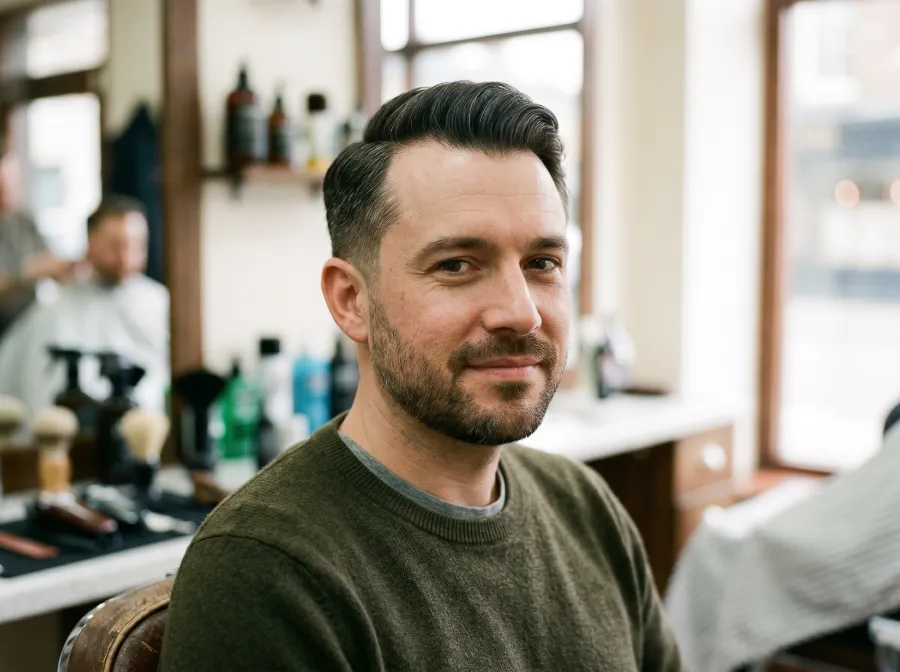
Side part (low, soft)
A classic that works while the hairline is only lightly receded. Keep it low and soft, not a hard slicked part, which would draw a line straight to the temple.
- Suits: Norwood 2, men in professional settings who want a tidy classic.
- Barber request: "Scissor cut, leave two inches on top, short back and sides with a low taper, soft side part."
Textured fringe / low quiff
A short, textured fringe nudged forward, or a low quiff with the front lifted gently up and slightly forward. Texture breaks up the light so the hairline never reads as a clean edge.
- Suits: Norwood 2–3, medium to thick hair.
- Barber request: "Textured fringe, point-cut on top for movement, low fade on the sides."

Ivy League
A longer crew cut with enough length at the front to sweep to the side. Sharp, grown-up, and easy to dress up or down — the best "office" option before recession advances.
- Suits: Norwood 2, men who want a smarter finish than a crop.
- Barber request: "Ivy League — about an inch on top tapering shorter to the crown, low taper sides, enough front to sweep over."

Best hairstyles for moderate recession (Norwood 3–4)
This is the textured-crop zone. A forward fringe directly covers the temple corners, and matte texture hides the scalp.
Textured crop
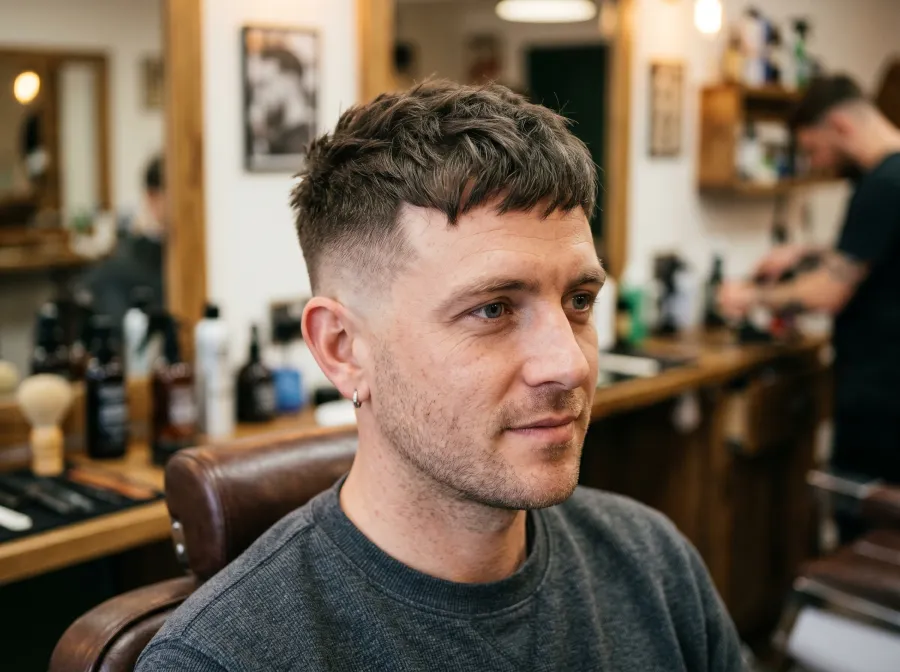
The single most reliable cut for moderate recession with hair to work with. Choppy 1–2 cm on top, a short fringe of 1–1.5 cm brushed forward, and a fade on the sides. The forward fringe sits over the recession line and the texture interrupts any clean edge.
- Suits: Norwood 3–4, medium-thickness hair with coverage at the front.
- Barber request: "Textured crop, about a #2 on top left choppy, short blunt fringe, mid skin fade on the sides."
French crop
The crop's messier cousin — a textured, choppy fringe over faded or tapered sides. A little more forgiving than the Caesar if your front is uneven, because the texture hides irregularity.
- Suits: Norwood 3–4, men who want a modern, low-effort look.
- Barber request: "French crop, textured fringe left a bit longer, low or mid fade — your call on the height."
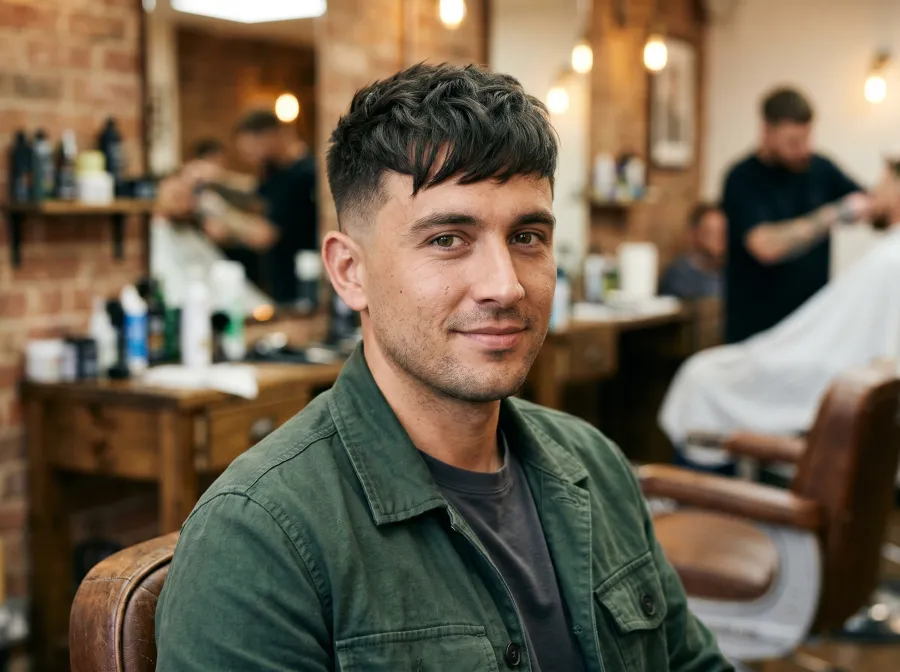
Caesar cut
The cleaner, more structured relative of the French crop: a short, blunt fringe straight across the forehead. That horizontal line pulls the eye sideways instead of up to the hairline, and it needs almost no product.
- Suits: Norwood 3–4, anyone who wants a sharp low-fuss classic.
- Barber request: "Caesar cut, about a #4 on top, blunt straight fringe, low skin fade on the sides."
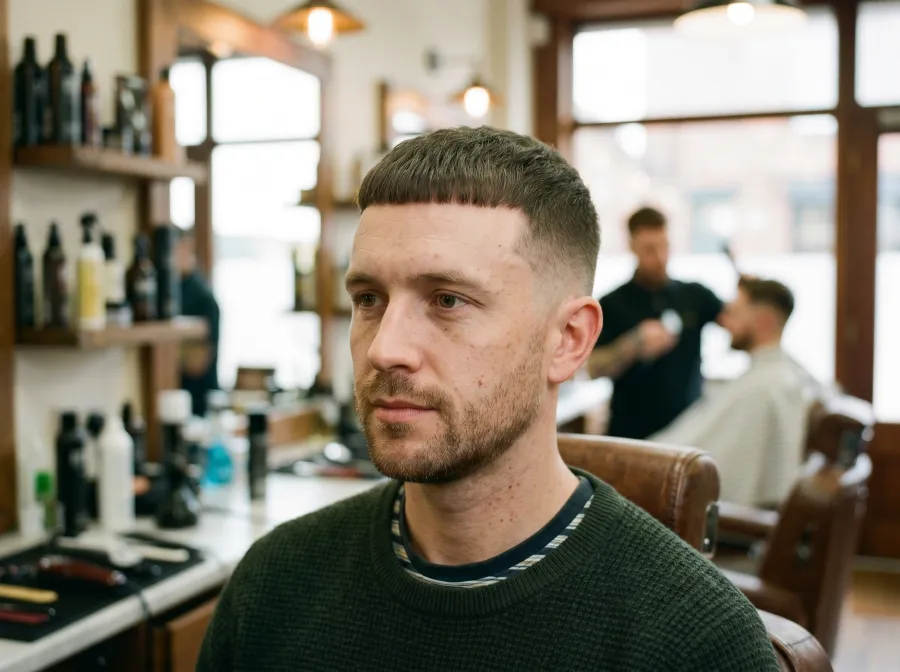
Crew cut
Short sides, an inch or two on top graduating shorter toward the crown, and a light fade that blends the temples in. Texturise the top and you get fullness up front where you want it.
- Suits: Norwood 3–5, low-maintenance men who still want a bit of shape.
- Barber request: "Crew cut, #3 to #4 on top graduating shorter to the crown, mid skin fade, texturise the top."

Best hairstyles for advanced recession (Norwood 5–6)
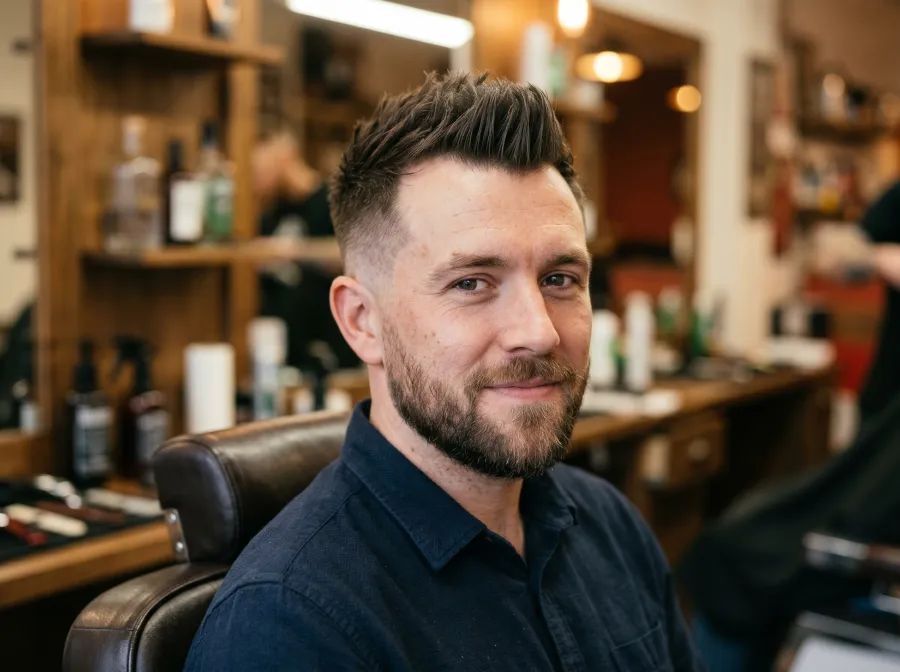
Past Norwood 5, the front and crown are merging. The honest, sharp move is short and even — and a beard becomes your best friend.
Buzz cut
When length is the same everywhere, the eye has no contrast to read, so the recession reads as a deliberate shaved style rather than a loss. Pair it with a low or mid skin fade — not a high fade, which can spotlight a receding temple.
- Suits: Norwood 4–6, a reasonable head shape, men who want zero styling time.
- Barber request: "#2 on top, low skin fade on the sides, square it off at the front."
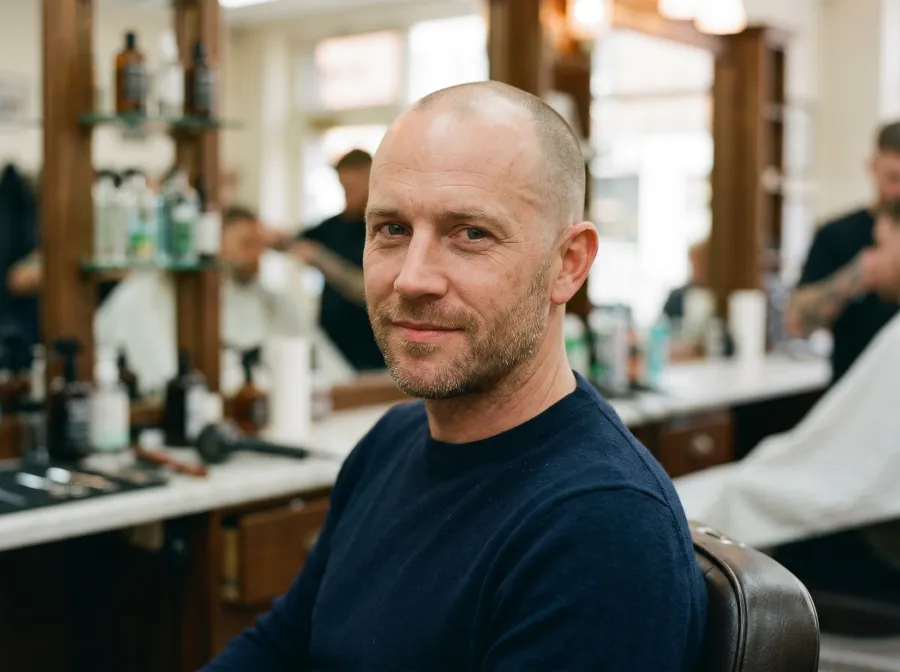
Short top with a full beard
Skin fade and short top up here, a full beard down there. The beard shifts the whole visual centre of gravity to the lower face. The hairline stops being the headline because the jaw is doing the talking — and the contrast that draws the eye downward genuinely works.
- Suits: any advanced stage, men who can grow a solid beard.
- Barber request: "Skin fade, short on top, and shape the beard full and clean along the jaw."
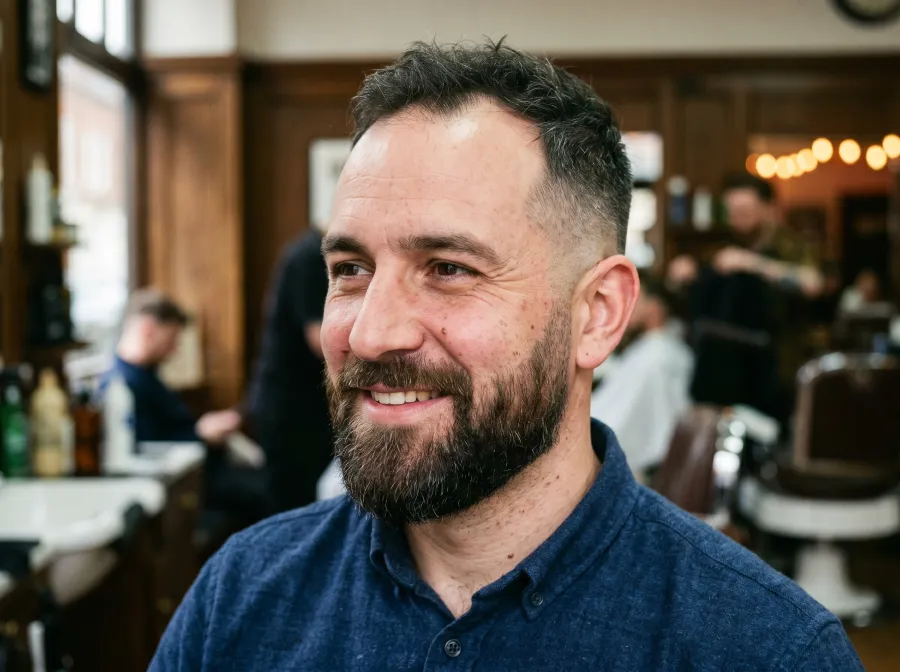
Faux hawk (textured, low-key)
Underrated for recession because it concentrates all the volume in a central strip and fades the sides hard, pulling attention to the middle and away from the temples. Keep it textured and matte, not spiked and shiny.
- Suits: Norwood 3–5, men who want something with a bit more edge.
- Barber request: "Textured faux hawk, leave the centre longer, burst or mid fade on the sides, matte finish."
Best move for heavy recession (Norwood 6–7)
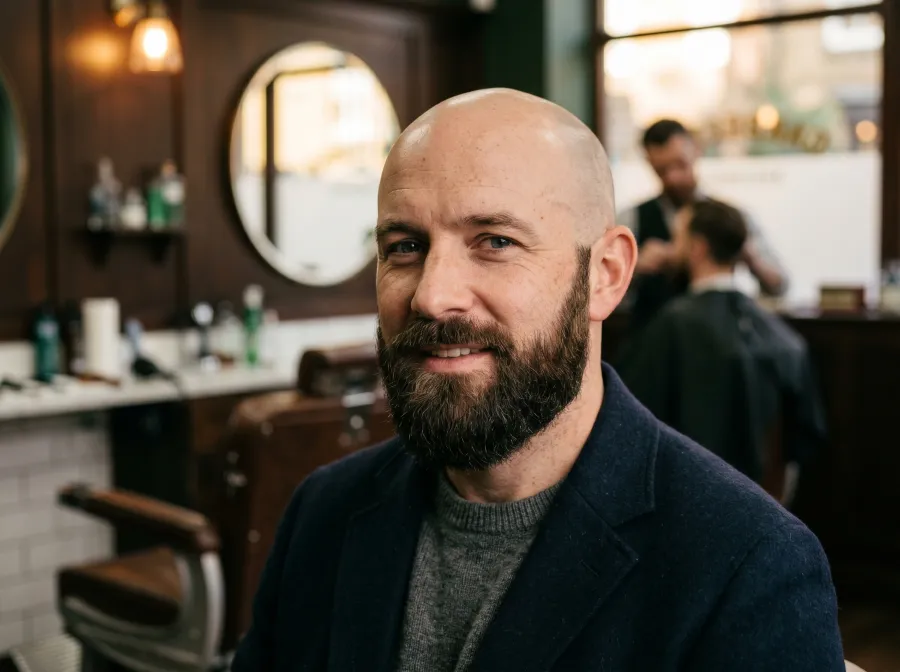
At Norwood 6–7 only a horseshoe remains, and the most confident-looking option is to stop chasing coverage entirely: a clean shave, or a very tight buzz paired with a strong, well-shaped beard. It reads as a choice, every time. There is a reason the shaved-head-and-beard combination is the most common look among men at this stage — it is the one that never looks like it is hiding anything.
What to avoid (and the science of why)
These all increase the scalp-to-hair contrast that makes recession obvious. Skip them at every stage.
- The combover. Long hair raked across a thin front draws a literal map of where the hair is missing. It is the single worst choice, and it fails the moment there is any breeze.
- The high pompadour. All that height up front frames the hairline like a spotlight. It only works at Norwood 2, and barely.
- Slicked-back, high-shine styles. Shine amplifies the tonal contrast between scalp and hair, and the backward direction vectors the eye straight to the recession. A flat, glossy slick-back puts an arrow on your hairline.
- Long, limp tops. Length needs a strong hairline to anchor it. Without one, it flattens and the thinning stands out more, not less.
- Tight styles — man buns, tight ponytails. Beyond looking wrong, the constant tension can cause traction alopecia and actively worsen recession over time.
How to style thinning hair so it looks fuller
The cut does most of the work. Styling finishes it. The goal is texture and separation without shine — because shine reflects off the scalp and amplifies exactly the contrast you are trying to soften. This is the matte-versus-glossy rule, and it matters more than which brand you pick.
A pea-sized amount of a matte product, worked through dry hair, lifts and separates the strands so they read as fuller than they are. The mistake most men make is using too much, which clumps the hair into wet-looking strings that show the scalp between them.
If your hair is fine as well as receding, the styling matters even more — fine hair flattens fast and needs lift at the root. Our volume guide for men with fine hair covers the drying technique that does half the work before any product goes in. And if the front is thinning but the rest is thick, the thick-hair styling guide shows how to balance the weight.
Da'Wax for texture and fullness
Da'Wax gives a matte, pliable hold that adds grip and separation without the greasy shine that highlights a thinning front. Use it on dry hair to build texture into a crop, a crew, or a Caesar.
- Dry your hair fully first.
- Scoop a pea-sized amount — less than you think.
- Warm it between your palms for five seconds.
- Work it through from back to front, finishing at the fringe.
- Push the front up and forward for lift, not flat and back.
- Add a touch more only if the shape will not hold.
Should you treat the hair loss itself?
This is a styling guide, not medical advice — but it is worth knowing your options, because the men who act early tend to keep the most hair. Male pattern baldness is cosmetic, not dangerous, and the NHS does not routinely treat it. If you do want to slow it, two treatments are FDA-approved and clinically backed:
- Minoxidil (topical, over the counter): stimulates the follicles and can reduce loss and thicken strands. The American Academy of Dermatology notes results take six to twelve months and stop if you stop using it.
- Finasteride (prescription tablet): blocks the DHT that drives the loss, and the AAD reports it slows further loss in roughly 80–90% of men who take it.
If your hairline is changing fast or patchily, see a dermatologist before assuming it is pattern baldness — conditions like alopecia areata look different and are treated differently. Either way, the right haircut works today, whatever you decide about treatment.
FAQ
What is the best haircut for a receding hairline?
It depends on your stage. For early recession (Norwood 2), a textured fringe, low quiff, or Ivy League keeps movement without framing the temples. For moderate recession (Norwood 3–4), a textured crop, French crop, or Caesar uses a forward fringe to cover the corners. For advanced recession (Norwood 5–6), a buzz cut or short top with a full beard is sharpest. The rule throughout: short, forward, and matte.
Should men with receding hairlines keep their hair short?
Generally yes, and more so as recession advances. Short, uniform length removes the contrast between the thinning front and fuller sides that makes a receding hairline obvious. Longer styles usually need a strong hairline to anchor them, so they tend to highlight recession instead of hiding it. A full beard with a short top is one of the strongest combinations at any stage.
What is the Norwood scale?
The Norwood (or Hamilton–Norwood) scale is the standard system dermatologists and hair surgeons use to classify male pattern baldness, running from Stage 1 (no loss) to Stage 7 (only a horseshoe of hair remains). Stage 2 is a normal "mature hairline," Stage 3 is the first clinically significant recession, and Stages 5 to 7 cover advanced loss. Knowing roughly where you sit helps you pick a cut that fits.
Does a receding hairline mean I'm going bald?
Not necessarily. A receding hairline at the temples in your twenties or thirties is often just a "mature hairline" — Norwood 2 — which most men reach and which is not the same as progressive balding. It can also be the first sign of male pattern baldness, which is hereditary. If the change is fast or uneven, a dermatologist can tell you which it is. Either way, choose a cut that looks good now.
What hairstyles should you avoid with a receding hairline?
Avoid the combover, the high pompadour, slicked-back high-shine styles, long limp tops, and tight styles like man buns. They all increase the contrast or tension that makes recession obvious — and tight styles can worsen it through traction over time. The combover is the worst offender: it maps exactly where the hair is missing and fails in any wind.
Can hair wax help thinning hair look fuller?
Yes, if it is a matte wax used sparingly. A pea-sized scoop worked through dry hair lifts and separates the strands, which adds the look of fullness. Avoid shiny or heavy products — shine reflects off the scalp and amplifies the contrast that makes thinning obvious, and weight clumps the hair so the scalp shows through.
Next step
Place yourself on the Norwood scale, pick the cut for your stage, and give your barber the exact request — clipper number included. Then style it matte, never shiny. For more on building volume into finer hair, start here: men's hairstyles for fine hair.
About the author. Angelika Young is a co-founder of Da'Dude, the men's grooming brand built on a family hair-salon heritage in Varberg, Sweden. She has worked behind the chair in the family's barbershop and spends her time researching and testing men's styling products. The styling guidance here comes from years of hands-on work with men's hair; the medical and hair-loss information is drawn from the cited sources below.
Sources: Cleveland Clinic — Male Pattern Baldness · American Academy of Dermatology — Hair Loss Treatment · Healthline — The Norwood Scale · NHS — Hair Loss
Comment