Seasonal Hair Care: Adapt Your Routine for Summer, Winter & Beyond
Oct 15,2025
Let me tell you something that most people never get: your hair is alive. Not in the biological sense, but it is responding, adapting, communicating with you every day. It is having a full-fledged conversation with the environment around you (and, guess what?) Most people are not listening to it. They are using the same shampoo in January that they used in July, and then wondering why they look like they've been electrocuted.
The truth is this: your hair is not being obstreperous. It is being responsive. And the moment you comprehend this, everything changes. You stop fighting your hair and start working with it. You stop blaming your genetics and start making intelligent modifications in your routine. Because it is this I know, after spending years studying the physiology of man in the matter of peak performance: Small, intelligent changes, compounded, mean great results. And that applies to everything, including what you have growing out of your head.
The object is not to change the entire routine every three months. The object is not to overstrain yourself to change your routine. The object is to adapt yourself intelligently. And I'm going to show you how to do it.

How Hair Cuticles Respond to Humidity
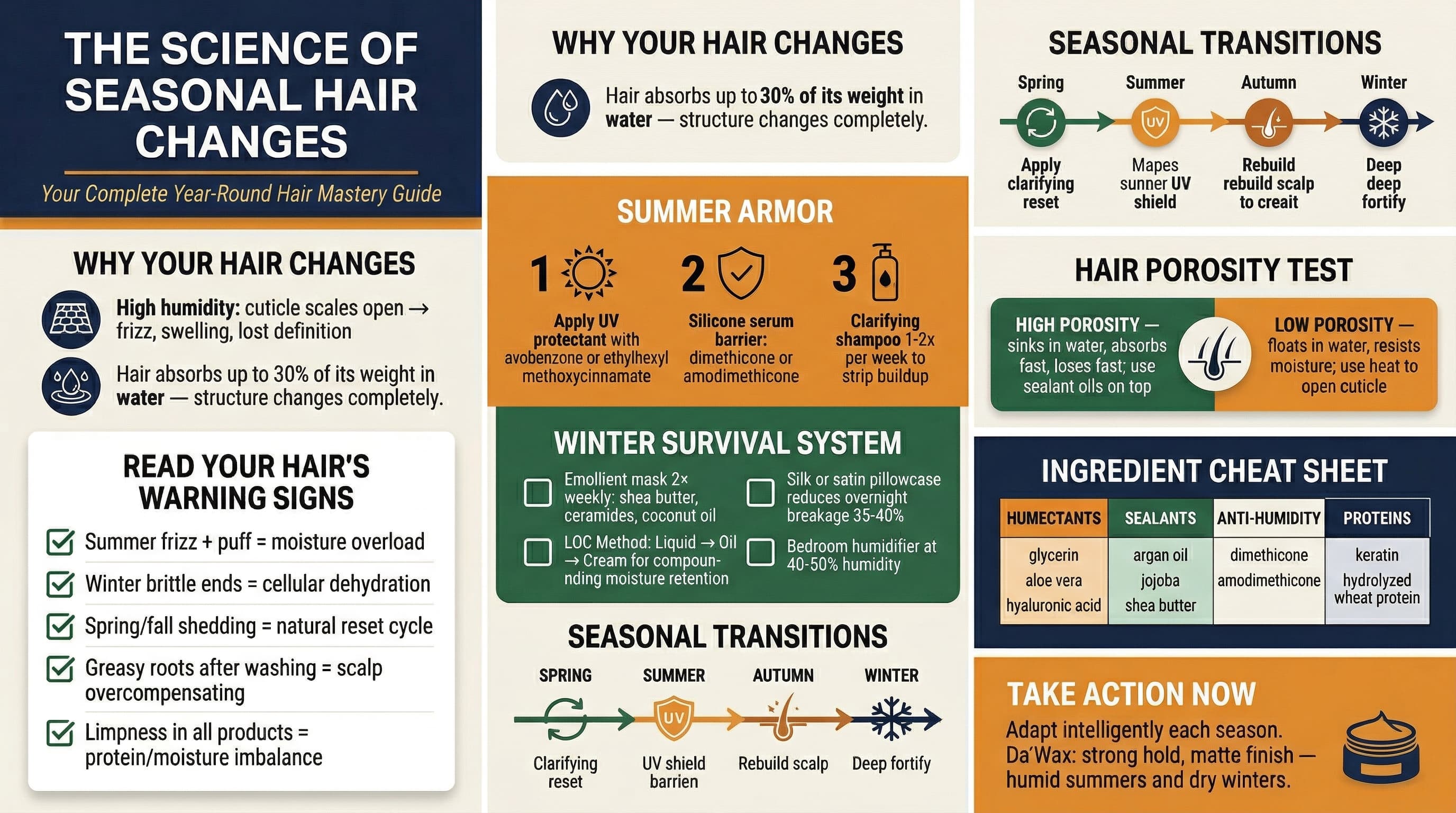
The hair cuticle, or the outside protective layer of each hair, acts and works like a little series of microscopic shingles that cover a roof. When moisture comes in the air and the humidity goes up, those little shingles or tiles go up, and moisture comes in the hair and explodes into frizziness, puffness, lack of definition, loss of control before you walk out of the door.
In a time of low humidity? The other bugaboo. Moisture steals out of the hair into the air. The cuticles remain flat, but the fibres are brittle, such that a mere touch will bring them to ruin. This is no delusion, but science. But here is what astonishes everybody—this is not all. The hair is only the shaft. The scalp is a living machine. Sebum-production (that is, oil) differs in amount according to heat and moisture. In warm weather the scalp secretes excessive oil owing to high temperatures and apparent dryness. In cold weather there is little or no secretion, consequently the scalp is parched dry.
Understanding Seasonal Hair Shedding
This is another stickler. Even the natural physiological ecdysis of the hair is at its maximum in summer and autumn. Research confirms that seasonal hair shedding peaks in autumn, which is one of the legacies of evolution. The coat is undergoing changes as the seasons change. But then we are met again by the vast amount of authority from trichologists and dermatological scientists that scientifically the hair cuticle can imbibe as much as 30% of its weight of water during periods of high humidity.
This is not a slight variation in amount at all. It means almost a complete alteration in structure. And when the arrival of winter brings with it the bonds of average centre heating which have to be time-worn blasted day and night inwardly, the hair has exhausted not less than 50% of its moisture retention capacity. It is upon this that depends the difference between hair that is well fed and healthy and hair that is strawenous in character and is broken into pieces as soon as it is given any stress whatever. In a word, the hair is not morose but makes a sane deduction from its condition of things brought about by the changing features in its environment. The trick is to take note of these medium changes in the environment and adjust one's tactics in accordance.
Reading Your Hair's Warning Signs
That is not fitness but accomplishment. Observing the Signs of the Times: The hair is talking—Are you listening? The key to success in everything-whether in business, relationships, physical fitness, hair care-is simply pattern recognition. Your hair is shouting out signals everyday.
Are you aware of them? These are the following signs you should be on the lookout for:
Frizz and puffiness in the summer? Your hair says, "I am getting far too much moisture penetration-I require a barrier!" This is not a cosmetic problem but a structural instability.
Dry brittle ends breaking off when brushed in the winter? Translate this: "I am in a dehydrated state, at the cellular level." I need moisture and a way to hold it."
New shedding in the spring or fall? Don't panic. This is your natural "reset cycle" of your body. If however, you are not supporting it with nutrition and scalp care, you are aggravating the problem unnecessarily.
Greasy roots upon the onset of summer, right after washing? Your scalp is overcompensating. There is too much oil being produced, because it perceives a foulness in the environment (such as too much stripping from a harsh product or too much heat or sweat.)
Splits and limpness no matter what hair styling products you try? You're out of balance. It means you have stiff, brittle hair from too much protein, or weak, limp hair from too much moisture.
Here is what I want you to understand: These problems are not random to be treated with random products, these are feedback signals. And feedback signals, when interpreted properly, are the breakfast of champions. They tell you exactly the deficiency that must be overcome. Stop seeing problems. Start seeing data.
Summer Hair Protection Strategies
Summer seems so easy. Great weather, good time, your hair should cooperate. Au contraire. The summer presents a two-fold assult on the hair: ultraviolet rays, chlorine, salt water, humidity spikes, and continual heat from blow-drying, curling, and straightening; you have places to go and people to see.
UV Protection for Hair
There is no other option but UV protection. Listen very well: the hair doesn't tan, it decomposes. The UV rays break down keratin protein of the hair shaft causing it to become brittle, lose its color and lose mechanical strength.
This is not cosmetic. This is structural damage to the hair at the molecular level. Use leave-in treatments or styling sprays with ultraviolet filters such as avobenzone or ethylhexyl methoxycinnamate. Think of it as sunscreen for the hair—because it is just that.
Anti-Humidity Products and Techniques
Anti-humidity products are your armor. Silicone-based serums or new-age polymer blends create a hydrophobic barrier around each hair, actually repelling excess moisture from entering the cuticle. I'm not talking about greasy, heavy products that weigh you down. I'm referring to fine, sophisticated products that will seal the cuticle but will allow movement and natural texture. Look for dimethicone, or cyclomethicone, or amodimethicone. Smart hydration is the key.
The hair needs moisture but it can't just be ANY moisture. It has to be the right kind of moisture. Leave-in conditioner products that are water soluble, with humectants like glycerin, like hyaluronic acid, like aloe vera, will provide moisture to the hair shaft without added weight. Think of it this way: the hair needs a drink of water, not to be submerged in a swimming pool. Less heat. Each time you turn up the heat to 400 degrees, applying heat from a flatiron or curling iron, you are cooking the proteins of your hair. Air dry whenever you can, or learn proper blow dryer techniques.
When you use heated appliances, and I get that sometimes you need them, use a heat protectant always before using heated styling appliances. Always. No exceptions.
Swimming and Chlorine Protection
Before hitting the pool or ocean, wet your hair with clean water and apply a leave-in conditioner or oil. Why? Wet hair absorbs way less chlorine and salt because it's already saturated—simple physics. After swimming, rinse immediately and follow up with a deep conditioning treatment to restore moisture and remove leftover chemicals or salt. For that effortless beach look, use proper products rather than relying on damaging salt water.
And here's the game-changer: clarify regularly. Sweat, sunscreen, styling products, and pollutants build up on your hair and scalp like layers of grime. Use a clarifying shampoo once or twice a week to strip away the buildup and reset your hair to its natural state. Think of it as a detox for your strands. Without this step, nothing else works as well.

Winter Hair Care Warfare
The winter is where the battle is lost. Outside is cold and dry, inside it is heated and even drier. Your hair is being assaulted from both sides. Its moisture can escape faster than it can replace it. This is a moisture disaster; it demands an absolutely different strategy.
Deep Conditioning Essentials
Deep conditioning is your bottom line. Luxurious masks, overnight treatments, and heavy creams full of emollients are not winter luxuries any longer. They are now necessities for survival. You want emollients like shea butter, avocado oil, coconut oils or ceramides which penetrate into the hair shaft deeply and repair the damaged cuticle layers. Once or twice per week minimum. Not optional.
Sealing Moisture with Natural Oils
For the love of all things holy, seal everything with natural oils—layer your protection. After you do all the leave-in moisturizing of lighter textures, seal them in with natural oils. Argan oil, coconut oil, jojoba oil—the application of these products will form an occlusive layer preventing moisture loss. This is referred to as LOC, or Liquid, Oil and Cream. You are creating layers of moisture retention that will compound the effect. One product alone will never work in winter. You need an entire system.
Protective Styling and Environment Control
Protective styling is not solely meant for textured hair. Low-manipulation styles—braids, buns, twists, updo's—will lessen how often your hair ends are exposed to the drying air, and how much breakage you receive from constant handling and friction.
And here's an additional thing that most people do not think of. Get silk/satin pillowcases. Cotton pillowcases will take moisture from the hair, and also cause the friction which results in breakage, tangling, and frizz.
Silk and satin won't. It will reduce overnight breakage from 35 to 40 percent! Forty percent. For the price of a pillowcase.
Run a humidifier—take control of your environment. If you cannot change the outside environment, change that of the inside. Using a humidifier in your bedroom or office raises the moisture level of the air to around 40-50%, and decreases the moisture differential between the hair and air appreciably. Your hair will benefit. Your skin will benefit. Your respiratory system will benefit. Win-win-win!
Shampoo less often—strategically! Every time you shampoo, you're washing away the natural oil made from your scalp, which is hard enough to keep up with production in cold weather. I'm not saying go weeks and weeks without washing—I'm saying go to intervals of days longer till you wash again, even if you may be extending the time only 1 or 2 days! Use dry shampoo in between hair washings if necessary.
Let your oils do some of the work for you—work with your nature not against it.
Navigating Transitional Seasons
Spring and Autumn are wild cards. Cool in the morning, warm in the late afternoon varying humiditionally, rain one day, sunshine the next. The hair does not know if it is coming or going. This is the time for the tactician in adaptability having the ability to overcome difficulties in your way.
Commence with a reset. Use a gentle clarifying organic product to take off any remaining accumulative residue of the previous season ie. built up from winter heavy products or summer chlorine and sunscreen residues. This is giving your hair a fresh page to work from. For the sake of product efficiency and absorption you know the importance of an "open book".
Gradually change the mediums of weight of products. Don't get up on the first day of spring and change your entire winter hair care programme for that of light summer formularies. Your hair and scalp will revolt. An altered regime over a period of a week to even two weeks will be required before the lighter products or heavier when more cooling. This change is welcome preventing shock and loss of continuity.
Look after the scalp—the foundation is essential. Use a scalp scrub or gentle exfoliation treatment to renew the dead and shed skin cellular particles. A healthy scalp is the foundation for the healthy growth of hair. If the foundation is messed up everything build upon it is jeopardised or threatened. Think of a scalp massage for the increased circulation to maintain a maximum condition of follicles.
A trim—take the wear and tear off the damage arrived at in the seasonal time. Take the split hairs, the damaged strands damaged by the elements of seasonal extremes before it has travelled the hair shaft further.
Even a quarter-inch trim every 6-8 weeks keeps a slight amount of damage from turning to big-bad breakage. Prevention is always cheaper than repair. Balance protein and moisture—this gets a little tricky. If your hair feels mushy or too soft and stretches too much when wet, you need protein treatments to reinforce the structure of the hair. If it feels dry, straw-like and brittle, you need moisture. Most people need both, but in different amounts depending upon the season and present condition of the hair. Protein treatments once a month, moisture treatment once a week, and then adjust according to how hair appears. This is art and science.

Year-Round Hair Care Principles
There are certain fundamentals that pertain regardless of season. These are the ground rules that underlie everything else: Regular cuts. Split ends cannot heal. They get worse farther up the shaft. Every 6-8 weeks at the very least cut off the damaged ends. Non-negotiable. Hydrate from within.
All the external products in the world will do little good to fix dehydrated hair if you're not drinking enough water and eating nutrient-rich food. Your hair is made up largely of keratin protein—do you eat enough protein? Omega-3 fatty acids? Biotin? Zinc? All are important ingredients to the whole hair-growing process. Not trivial details. This is input of food base.
Understanding Hair Porosity
Understand the hair porosity. This is important. High porosity hair (generally damaged or chemically treated) absorbs moisture quickly but releases it just as rapidly. Low porosity hair (generally healthy, non-treated hair) repels moisture but holds it once it goes through. It is the porosity of your Hair which determines what products will work and what will not. Understanding hair can absorb up to 30% of its weight in water helps you manage moisture balance.
This is how to find out: Take a clean hair and put it into some water. If it sinks at once, it has high porosity; if it floats it has low porosity.
Products must be selected accordingly. If you have fine hair, you'll need lighter products that won't weigh your strands down.
You should rotate products carefully, and not in a hurry. Do not change all at once. Your hair should be allowed to attain some uniformity, so that it can show you what products actually will work. Change one variable, note the result for two or three weeks, and change. This is systematic experimenting, not random trial and error. You should always permit feedback from the results. If your hair is responding in shine, ease of styling, less breaking off, it is evident that you are on the right road. If it is not changing for the better, or is getting worse, alter your habits now. It is not very complicated. It is but a question of seeing patterns.
Strategic Product Ingredients
Man your inventory of strategic ingredients. Here is your primer for product selection:
Humectants (which bring moisture from the air to your hair): glycerin, aloe vera, hyaluronic acid, honey, panthenol.
Sealants and oils (which keep moisture in): argan oil, jojoba oil (derived from the nut of the jojoba plant), shea butter, coconut (palm) oil, grape seed oil.
Anti-humidity agents (which repel excess moisture from the atmosphere): dimethicone, cyclonethicone, amodimethicone, VP and VA copolymer.
Proteins (which strengthen and repair the structure): keratin, hydrolyzed wheat protein, silk amino acids, collagen; use moderately, for to excess, causes brittleness.
Mild cleansers: no sulfate or low-sulfate compound type of shampoos made with cocamidoprophyl betaine, decyl glucoside, coco-glucoside.
UV protection out of ethylhexyl methoxycinnamate, avobenzone, titanium dioxide or zinc oxide. Mix and match according to the condition of your hair, not by the mental picture of some cookie-cutter combined complexity, others have written Peter's principles on some other part of the thing. Every one of which must be made for your special necessities. For how much hair wax to use, start small and build up based on your hair's needs.
Take Action Now
Now understand, adjusting your hair regime according to the seasons is not rocket science but it does involve 2 things: awareness and intention. Gradual but systematic changes, consistently made, create mulitplied effects; therefore producing will be remarkable changes at the appropriate period of time. That's the way real change occurs—by not changes which certainly can't be continued but decided irrespective of system adjustments which again, can be controlled. See this—Start paying attention to what your hair says to you, try out the protective styling, alter your hydration content according to environmental situations, observe what is working and what is not. Write it down. This is your laboratory and you're the scientist here.
Your hair can be flexible, adaptable and well-conditioned through all every temperature and humidity change throughout the year. The whole question however, becomes this: are you going to meet it halfway? Are you willing to put in the awareness and effort into it that will it take to master this part of yourself which is being presented to the world?
The decision is entirely up to you. But I can say this, wherever you're creating variables you can control—seasonal adaptations, product adaptations, protective device—everybody is reduced finalized those problems. Your hair will turn into the great party ever instead of any cause of generations. And that's worth a lot.
For the perfect finishing touch in any season, Da'Wax delivers strong hold with a matte finish that works in both humid summers and dry winters. If you want to prevent frizz while maintaining style, the right combination of technique and product makes all the difference.
Now go into action. Great hair is at this both waiting for you.
Comment