

Here’s something most of us never stop to consider: your hair is in constant conversation with the world around it. Every shift in temperature, every drop in humidity, every blast of central heating — your hair feels all of it and responds accordingly.
And yet, so many of us are still using the same shampoo in January that we used in August, then wondering why our strands look dull, frizzy, or limp.
The truth? Your hair isn’t being difficult. It’s being responsive. The moment you understand that, everything changes. You stop fighting your hair and start working with it. You stop blaming your genetics, your texture, your hormones — and start making smarter, season-specific decisions.
You don’t need to overhaul your entire routine every three months. You just need to adapt your women’s seasonal hair care routine — intelligently. This guide will show you exactly how.
Why Your Hair Changes With the Seasons
The Science of Your Hair Cuticle
Think of your hair cuticle (the outer protective layer of each strand) like a series of tiny overlapping scales, similar to roof tiles. When the air is humid, those scales lift and moisture rushes in — hello, frizz, puffiness, and unruly curls that won’t cooperate before you’ve even left the house.
In low humidity? The opposite happens. Moisture escapes from the hair into the dry air, leaving your strands flat, brittle, and prone to snapping.
It goes deeper than the shaft, too. Your scalp is a living ecosystem. Oil (sebum) production shifts with the seasons — your scalp tends to over-produce in heat and under-produce in the cold, meaning you’ll experience greasiness in summer and tightness, flaking, or itchiness in winter. Understanding scalp care and sebum balance is the foundation for managing both extremes all year round.

Seasonal Shedding: What’s Normal for Women
If you notice more hair on your brush in autumn, don’t panic. Research confirms hair shedding naturally peaks in autumn — it’s an evolutionary cycle your body goes through as the seasons shift. That said, supporting your scalp with proper nutrition and care during this time can make a real difference in how dramatic the shed feels.
Here’s another fascinating fact: understanding hair cuticle structure and how it responds to humidity reveals why your hair behaves so differently season to season — your cuticle can absorb up to 30% of its own weight in water during periods of high humidity. That’s not a minor fluctuation — that’s a near-complete structural change. And in winter, with central heating blasting around the clock, your hair can lose up to 50% of its moisture retention capacity. Understanding this is the foundation of smart seasonal care.
Reading Your Hair’s Seasonal Warning Signs
Your hair is sending you signals every single day. Learning to read them is the real key to great hair at any time of year.
Frizz and puffiness in summer? Your hair is absorbing too much atmospheric moisture. It needs a protective barrier.
Dry, brittle ends that snap when you brush in winter? Your hair is dehydrated at a structural level and desperately needs moisture — plus something to lock it in.
Extra shedding in spring or autumn? This is your body’s natural reset cycle. Support it with scalp care and a nutrient-rich diet rather than fighting it.
Oily roots shortly after washing, especially in summer? Your scalp is overcompensating — likely because a product is stripping it too harshly, or because sweat and heat are throwing off its natural balance.
Limp, lifeless hair no matter what you use? You may be out of protein-moisture balance. Too much protein leaves hair stiff and brittle; too much moisture leaves it soft and weak.
Stop seeing these as problems and start seeing them as data. They tell you exactly what your hair needs — you just have to listen.
Summer Hair Care for Women: Protection Is Everything
Summer sounds idyllic, but it’s actually one of the most damaging seasons for your hair. UV rays, chlorine, salt water, humidity spikes, and the constant temptation to style and go — it’s a lot for your strands to handle.

Protect Against UV Damage
This is non-negotiable: your hair does not tan, it degrades. UV rays break down the keratin protein in your hair shaft, causing brittleness, colour fade, and structural damage. Think of UV protection for your hair the same way you think of SPF for your skin — essential, not optional.
Look for leave-in treatments, mists, or styling sprays with UV filters such as avobenzone or ethylhexyl methoxycinnamate. If you colour your hair, UV protection is even more critical, as coloured strands are more porous and far more vulnerable.
Use Anti-Humidity Products Strategically
Anti-humidity products are your summer armour. Silicone-based serums and polymer blends create a hydrophobic barrier around each strand, physically repelling excess moisture from penetrating the cuticle. Look for ingredients like dimethicone, cyclomethicone, or amodimethicone — these seal the cuticle without the heavy, greasy feel you might expect.
For moisture, choose lightweight, water-soluble leave-in conditioners with humectants like glycerin, hyaluronic acid, or aloe vera. These hydrate without weighing your hair down. Think of it as giving your hair a sip of water — not drowning it.
For a style that works with your hair’s natural summer texture, a sea salt spray for beach waves can create effortless volume and movement while working with humidity rather than against it.
Reduce Heat Styling Where You Can
Every time you reach for that straightener or curling iron at high temperatures, you’re cooking your hair’s proteins. Air dry whenever possible. The ongoing debate around blow drying vs air drying for hair health is especially relevant in summer, when your hair is already heat-stressed from UV exposure and humidity. When you do use heat tools, always — always — apply a heat protectant first. No exceptions.
Protect Your Hair Before You Swim
Before hitting the pool or beach, saturate your hair with clean water and a leave-in conditioner or oil. Wet hair absorbs significantly less chlorine and salt because it’s already full — simple physics working in your favour. After swimming, rinse immediately and follow up with a deep conditioning treatment.
And here’s a step many women skip: clarify regularly in summer. Sweat, sunscreen, and product buildup preventing your hair from styling properly accumulate on your scalp and strands like layers of grime. A clarifying shampoo once or twice a week cuts through it all. Without this reset, nothing else performs as well as it should.
Winter Hair Care for Women: A Moisture-First Strategy
Winter is where most hair routines fall apart. Cold, dry air outside. Heated, even drier air inside. Your hair is being attacked from both directions simultaneously, and its moisture is escaping faster than it can be replaced. This season calls for a completely different approach.

Make Deep Conditioning Non-Negotiable
Rich masks, overnight treatments, and nourishing creams are not winter indulgences — they are survival tools. Look for emollient-heavy ingredients like shea butter, avocado oil, coconut oil, and ceramides, which penetrate deep into the hair shaft and repair the cuticle from within. Aim for at least one deep conditioning treatment per week. This is not optional.
Layer Your Moisture With Oils
Think of winter moisture as a layering system, not a single product fix. After applying a lightweight leave-in conditioner, seal everything in with a natural oil — argan oil, jojoba oil, or coconut oil work beautifully. This creates an occlusive layer that traps moisture inside the strand and prevents it from evaporating. This approach is often called the LOC method (Liquid, Oil, Cream), and it genuinely works.
Embrace Protective Styling in Winter
Low-manipulation styles — braids, buns, twists, chignons — aren’t just stylish. They’re protective. Keeping your ends tucked away reduces their exposure to dry, cold air and minimises the friction and breakage that comes from constant handling. In winter especially, your ends need all the help they can get.
Switch to a silk or satin pillowcase. Silk pillowcases and their benefits for hair and skin are well documented — significantly reduced overnight friction, breakage, and moisture loss compared to cotton. Silk and satin are smooth, moisture-retaining, and gentle. It’s the easiest hair upgrade you’ll ever make.
Run a Humidifier for Healthier Hair
You can’t change the weather, but you can change your indoor environment. A humidifier in your bedroom or workspace, set to around 40-50% humidity, significantly reduces the moisture differential between your hair and the surrounding air. Your hair benefits. Your skin benefits. Your sleep benefits. It’s a genuine win on all fronts.
Stretch Your Wash Days in Winter
Every shampoo strips some of your scalp’s natural oils — oils that are already in short supply during cold months. You don’t need to go weeks without washing, but stretching your wash days by even one or two extra days can make a noticeable difference. Use a dry shampoo at your roots between washes to keep things fresh. Work with your scalp’s natural rhythm, not against it.
Spring & Autumn: Navigating the Transitional Seasons
Spring and autumn are wild cards. Cool mornings, warm afternoons, unpredictable humidity, rain one day and sunshine the next. Your hair doesn’t know whether to hold onto moisture or release it, and confusion often shows up as frizz, limpness, or increased shedding.
Start with a reset. Use a gentle clarifying treatment to remove the residue of the previous season — whether that’s heavy winter creams or summer’s chlorine and sunscreen build-up. This gives your hair a clean slate and helps new products absorb properly.
Transition your products gradually. Don’t swap from your full winter routine to a light summer one overnight. Your hair and scalp will revolt. Ease into lighter (or heavier) formulas over one to two weeks.
Prioritise scalp care. A scalp scrub or gentle exfoliating treatment removes dead skin cells and keeps your follicles clear and healthy. Pair it with a scalp massage to boost circulation — this supports healthy growth and feels absolutely wonderful in the process.
Book a trim. The wear and tear of seasonal extremes accumulates at your ends first. A small trim — even just a quarter inch — every 6-8 weeks prevents split ends from travelling up the shaft and causing widespread damage. Prevention is always less expensive than repair.
Balance your protein and moisture. If your hair feels mushy and stretches excessively when wet, it needs protein. If it feels dry, straw-like, and snaps easily, it needs moisture. Most women need both, just in different ratios depending on the season and their hair’s current condition. A protein treatment once a month and a moisture treatment weekly is a solid baseline — adjust as you observe how your hair responds.
Year-Round Women’s Hair Care Foundations
Regardless of the season, these principles always apply:
Get regular trims. Split ends don’t heal — they travel. Cutting them off every 6-8 weeks is the most effective damage control you have access to.
Hydrate from the inside out. External products can only do so much. Hair is primarily made of keratin protein, so eating enough protein, omega-3 fatty acids, biotin, and zinc matters more than most people realise. Your hair reflects your nutrition — what goes in shows up on the outside.
Understand your hair’s porosity. High porosity hair (often chemically treated or heat damaged) absorbs moisture quickly but loses it just as fast. Low porosity hair (usually untreated, healthy hair) repels moisture initially but holds it well once it’s absorbed. Knowing your porosity tells you which products will actually work for you. If you have naturally curly or wavy hair, porosity plays an even bigger role — discover how Swedish hair care for women with curly hair addresses these unique seasonal needs.
To test it at home: place a clean strand in a glass of water. If it sinks quickly, you have high porosity hair. If it floats, you have low porosity hair. Products should be chosen accordingly.
Change one thing at a time. When adjusting your routine, don’t overhaul everything at once. Change one product or step, observe the results for two to three weeks, then adjust again. This turns your haircare routine into a system that actually works — rather than an endless cycle of random experimenting.
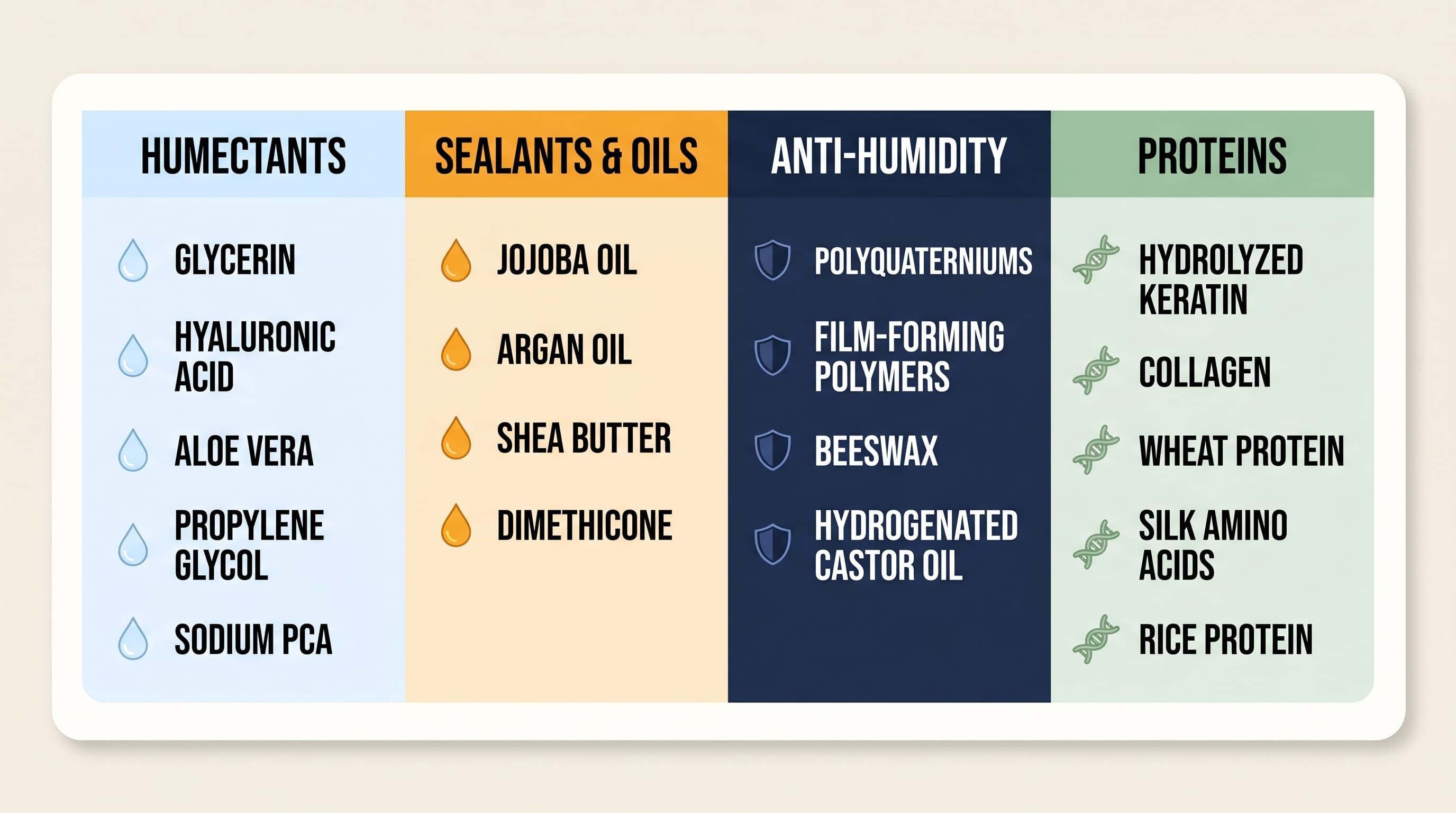
Seasonal Hair Care Ingredient Guide for Women
Here’s a quick reference for choosing the right products, whatever the season:
Humectants (draw moisture from the air into your hair): glycerin, aloe vera, hyaluronic acid, honey, panthenol.
Sealants and oils (lock moisture in): argan oil, jojoba oil, shea butter, coconut oil, grapeseed oil.
Anti-humidity agents (repel excess atmospheric moisture): dimethicone, cyclomethicone, amodimethicone, VP/VA copolymer.
Strengthening proteins (repair structure): keratin, hydrolysed wheat protein, silk amino acids, collagen. Use these moderately — too much protein causes stiffness and brittleness.
Gentle cleansers: sulphate-free or low-sulphate shampoos with ingredients like cocamidopropyl betaine, decyl glucoside, or coco-glucoside.
UV protection: ethylhexyl methoxycinnamate, avobenzone, titanium dioxide, or zinc oxide.
Start Your Seasonal Hair Care Routine Today
Adapting your hair care to the seasons doesn’t require a complete overhaul of your bathroom shelf. It requires two things: awareness and intention. Start paying attention to what your hair is telling you. Make small, deliberate changes. Track what works. Adjust as needed.
Your hair can be healthy, strong, and beautiful through every season — humidity and all. The only question is whether you’re willing to meet it halfway.
Start today. Your best hair year is already waiting.
Looking for the right products to take your seasonal routine to the next level? Browse our full range of nourishing treatments, heat protectants, and styling essentials — formulated to keep your hair at its best in every season.


